
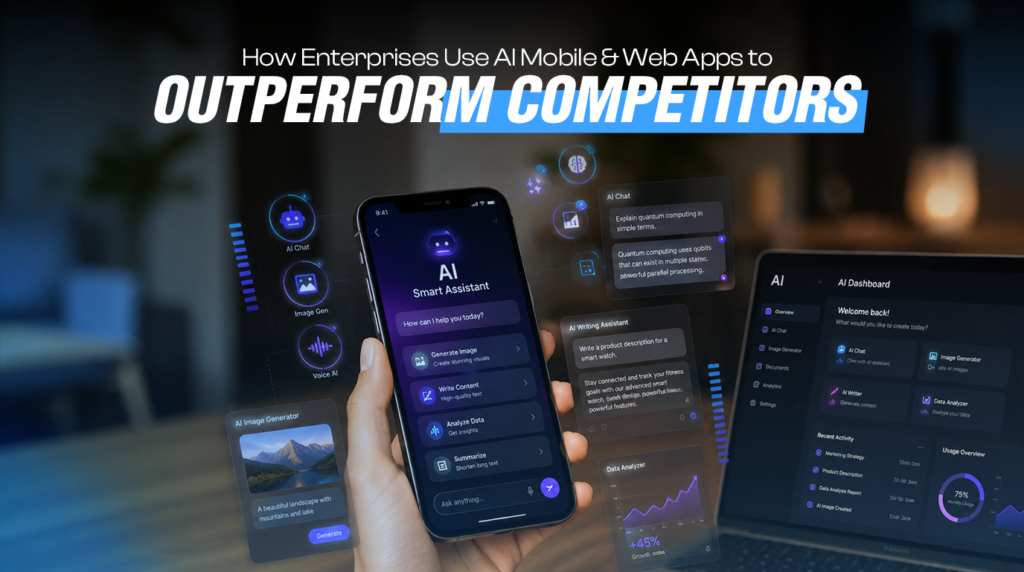
How Enterprises Use AI Mobile & Web Apps to Outperform Competitors?
It’s obvious that something is changing within the realm of enterprise technology and that it’s happening very quickly, too. Companies who used off-the-shelf software as a solution will now be facing limits in terms of performance, while companies that are focusing on building custom AI-powered mobile and web apps will start dominating. By 2026, it will no longer be an option. It will be a necessity for companies wishing to succeed. Digital Minds Dubai has observed trends within all different industries and found that the companies that succeed are not only using but also developing systems suited for their workflow, client behavior, and speed.
Why Are Generic Software Solutions Losing Their Edge?
Off-the-shelf software was designed for convenience. It allowed enterprises to get up and running faster without large investments. However, today, all competitors in an industry use similar technologies. The same dashboards with the same processes and restrictions. This means that there is one problem that does not immediately become apparent: there is no differentiation. By 2026, the key issue that executives are concerned about will be completely different, like control:
- Customer experience control
- Data flow control
- Automation logic control
- Scaling direction control
Generic tools dictate how business must work around the tool; custom AI solutions flip that dynamic. Rather than fitting your processes to a tool, you fit a tool to your processes.
What Makes AI-Powered Apps Different in Practice?
Most debates surrounding AI applications fail to offer concrete arguments. The phrase “smarter systems” is too broad. The fact of the matter is that AI-driven mobile and web apps provide the following benefits:
- Predictive intelligence
AI tools do not just illustrate what already happened but predict what will happen next. These are:
- The use of AI to predict all possible delays
- The use of software to score prospects on their ability to close deals
- Dashboards that notify about the possible issues that can impact performance.
- Hyper Personalisation
Every engagement with the customer becomes personalized based on their behaviors and intentions. It’s not about personalisation like “Hi Ahmed,” but more like:
- Dynamic interfaces according to use
- Dynamic recommendations according to use
- Auto-adjusted customer journey
Here we see where the impact of AI becomes more visible in terms of engagement and sales.
Inside AI Mobile Apps: Automated Workflows Without Human Intervention
AI applications not only present information but also perform tasks. Within an AI mobile app:
- Approval processes become automated
- No data entry is needed
- Notifications become smart
- Workflow happens without human interference
It is at this point that automation of workflows gets integrated into the platform rather than being separate systems. Up to 80% of all mobile apps will become powered by AI by 2026, while over 70% of the CEOs see generative AI as a means of increasing competitiveness. It is clear that AI technology is not futuristic; it is changing businesses now.
How Are AI Apps Changing the Way Businesses Run Day-to-Day Operations?
The most significant efficiencies are gained through internal applications.
Custom AI apps optimize:
- Approvals
- Compliance monitoring
- Resource management
- Reporting
By integrating this technology with AI business process automation, organizations gain smooth operations between departments.
The Evolution of Customer Journeys in the Age of AI
Your digital front end acts as your sales pitch. In certain industries like real estate, travel, and services:
- Smart property platforms would allow instant buyer qualification.
- An intelligent travel website would create customized schedules.
- Service bookings apps would convert customers without any human intervention.
This is how property intelligence tools and AI assistants generate revenue even before a human gets involved.
How Do AI Systems Convert Data Into Better Decision Making for Businesses?
All interactions in an AI custom application system turn into intelligent data.
When combined with real-time business intelligence, the executive is supplied with:
- Live performance information
- Revenues forecasting
- Risks recognition
- Automatically created reporting levels
This ends delayed reporting and replaces it with continuous intelligence.
AI-Powered Customer Communication and Lead Management
By 2026, AI assistants will be embedded into all business applications.
The assistants will be capable of:
- Lead generation
- Immediate customer responses
- Follow-up handling
- Support discussions
With the help of AI-powered call handling, companies can cope with high traffic without having to increase their workforce. With voice functionality using conversational technologies, you will have an income machine that works around the clock.
Custom vs Off-the-Shelf: Which Approach Works Better for Enterprises?
The common dilemma for all organizations is to continue with general solutions or move ahead and adopt AI-based custom solutions. General solutions prove beneficial initially because of their easy deployment and low costs. But on a larger scale, certain constraints become evident:
- Constrained workflow
- Lack of flexibility in automation
- Data held in external sources
- Inability to adapt to changes
This is resolved through custom AI mobile/web applications, which give you complete control over:
- Business logic
- Data structure
- User experience
- Direction of scaling
You are now independent from the vendor’s roadmaps; instead, you have your own.
Building a Connected AI Ecosystem Across the Business
The most successful companies are not using isolated technologies; they are creating AI ecosystems. This may include the following:
- A customized app for lead and transaction capture
- AI-assisted call handling for incoming communications
- Workflow Automation tools for internal processes
- Real-time business intelligence for decision making
- Enterprise AI development connecting everything
As opposed to separate technologies, everything works in one continuous loop of intelligence.
Why Does This Matter More in 2026 Than Ever Before?
The contest is no longer about having the bigger budget or larger team. It’s about the systems. AI-driven organizations:
- Act quicker
- Learn quicker
- Automate quicker
- Make decisions quicker
Quicker actions lead to an exponential speed advantage compared to traditional and scattered systems.
What Does This Really Mean For Businesses Today?
AI-based mobile and web applications are not add-ons anymore; they are now the building blocks of any modern organization. The trend seen at Digital Minds Dubai is that companies are no longer just using software; instead, they are now harnessing intelligence systems. The big debate is no longer about the efficiency of AI; rather, it should be on how conventional systems will stand a chance against those systems that are automated, predictable, and optimized all the time. By 2026, success will be in favor of the businesses that make the most intelligent use of systems.
Frequently Asked Questions (FAQs)
It is an application designed to predict results, automate processes, and personalize experiences with AI technology.
AI applications can learn from the data and user interactions; standard apps have no such features.
Custom development allows greater flexibility; ready-made tools do not provide enough capabilities.
Most companies report significant ROI on the investments in AI technology.
Real estate, logistics, health care, transportation, banking, and e-commerce.