
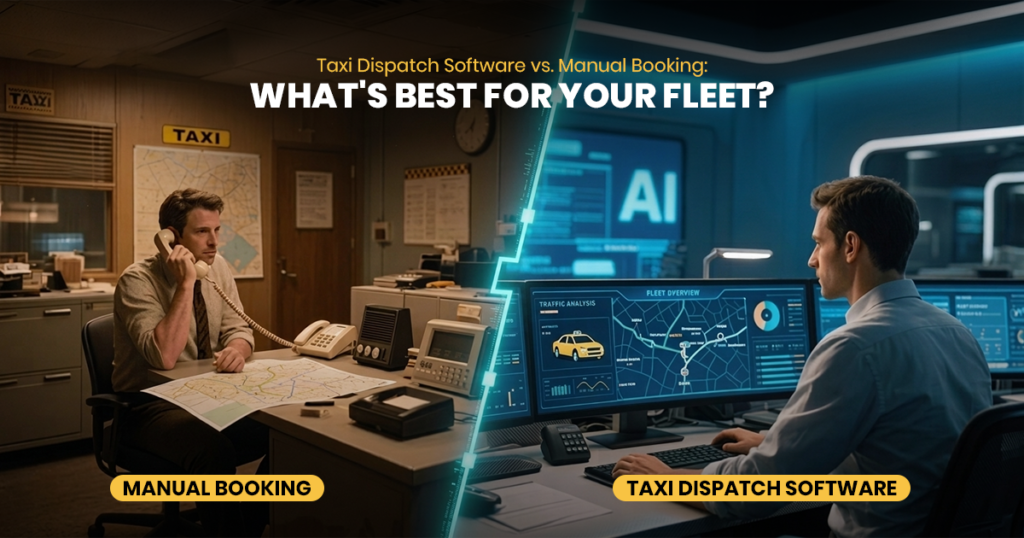
Taxi Dispatch Software vs. Manual Booking: What’s Best for Your Fleet?
The management of modern taxi fleets involves far more than simply taking calls and allocating drivers. Clients need rapid booking processes, instant information, digital payment, and guaranteed delivery every time. Most fleet managers use manual booking systems. This might not be an issue if your fleet is small, but things will definitely get complicated if the number of bookings increases. Are you thinking of shifting to Taxi Dispatch Software? Then here is a quick comparison.
What Is Manual Booking?
Manual booking includes booking rides through calls or messages and then allocating drivers manually. This system can be functional when dealing with a smaller fleet. But as the number of vehicles increases, it leads to delays and inefficiencies. Problems may include:
- Failure to answer customer calls
- Overbooking
- Assigning the wrong driver
- Extended waiting times
- Reduced visibility of the fleet
- More administration
Such problems may hamper customer service and business expansion.
What Does Taxi Dispatch Software Do?
In today’s advanced taxi dispatch system, the process is automated. When a ride request is received, the system instantly chooses the best driver for the job, assigns the ride, and informs both the driver and passenger right away. Rather than depending on phone calls and spreadsheets, all these activities can be carried out using a single dashboard. Some of its basic functionalities include:
- Driver assignment automation
- Real-time GPS location tracking
- Passenger application
- Driver application
- Payment integration
- Route optimization
- Management of trips
- Analytics and reporting
This leads to increased efficiency as well as satisfaction among both passengers and drivers.
The Hidden Costs of Manual Dispatching
Most fleet management companies undervalue just how expensive manual dispatching can become as their company scales. The process which began simply enough as basic and inexpensive operations such as phone calls and Excel sheets evolves to become increasingly inefficient, lowering performance and earning power.
- Missed Bookings
Dispatchers who are too busy to attend to every phone call will lose out on bookings.
- Low Driver Efficiency
Drivers who aren’t intelligently matched end up wasting time waiting around, rather than earning.
- Human Errors
Small things like incorrect pick-up points and other assignment-related errors could cause problems.
- No Performance Tracking
There’s no tracking or performance metrics to monitor in a manual dispatching system.
- Inefficient Scaling
Scaling becomes increasingly difficult because hiring more employees is still inefficient.
Taxi Dispatch Software vs. Manual Booking
When compared side-by-side, the contrast becomes clear. Manual booking might be effective for smaller organizations, but with time, its inefficiencies begin to show.
| What Matters | Manual Booking | Taxi Dispatch Software |
|---|---|---|
| Booking Time | Requires a few minutes | Happens instantly |
| Driver Allocation | Manual assignment | Automatic assignment |
| Tracking | Poor visibility of drivers | GPS live tracking |
| Customer Experience | Inconsistent | Highly reliable |
| Peak Hour Performance | Struggles under pressure | Handles high demand easily |
| Reporting | Limited analysis on spreadsheets | Advanced real-time analytics |
| Scalability | Needs more staff to grow | Scales easily with fleet |
| Operational Visibility | Very limited | Fully transparent |
As the fleet expands, the distinctions become ever more pronounced.
When Should You Make the Switch?
However, while operators may wait until their business begins suffering before making changes, it would be best for them to act sooner, while there is still time. Operators will need to move to a dispatch solution when:
- Customers complain about delays
- Dispatching becomes difficult during peak hours
- Driver reliability is poor
- Operator lacks visibility into their fleet performance
- Too much administrative time is consumed
- Operators plan to increase the service area
Current solutions are simple to implement and less complicated than one might think.
Modern Dispatch Systems Go Beyond Taxis
In today’s world, the transport industry cannot simply focus on providing the taxi service alone. This means that the system must incorporate various services within one platform. An AI-powered chauffeur management system is ideal for premium transportation services, as it allows the company to automatically manage schedules, clients, compliance, and billing. AI business automation tools are common within such organizations. All this leads to a more effective transportation business.
Features to Look for in Fleet Management Software
However, not all dispatch platforms have the same features. It is important to pick out those that will actually enhance your operations.
- Real-Time GPS Tracking
Live vehicle tracking ensures that all operations in the fleet are visible at once, as well as providing estimates for customer arrival times.
- Automated Dispatching
An effective dispatch system should be able to automate booking according to driver efficiency.
- Passenger Booking Application
It makes it possible for customers to make ride requests quickly without putting any strain on the dispatchers.
- Driver Application
It is an all-in-one app that allows drivers to accept trips, get route guidance, check their statuses, and earn income.
- Reporting and Analytics
Provides useful information on bookings, income, performance of drivers, and trends.
- Integrations
Connects easily with other business apps, such as accounting, CRM, and payment processing.
Frequently Asked Questions (FAQs)
Yes. The software can be useful even for companies with up to five taxis.
In most cases, yes. The savings arise from increased driver efficiency, minimized booking mistakes, and less manual labor.
All contemporary systems offer capabilities related to payment processing along with compatibility with various payment gateways.
Cloud-based systems can be implemented in several days, depending on the scale of the company’s fleet.
Why Modern Fleets Are Switching to Automation?
Manual booking was effective in the past, but now, with the changing trends, faster ways of managing bookings are needed by most fleets. The use of Taxi Dispatch Software allows for automation in bookings, better utilization of drivers, reduced expenses, and fleet visibility in real-time.
If you’re having trouble keeping up with the demands of a growing business, then investing in a new dispatching system is definitely the way to go.