
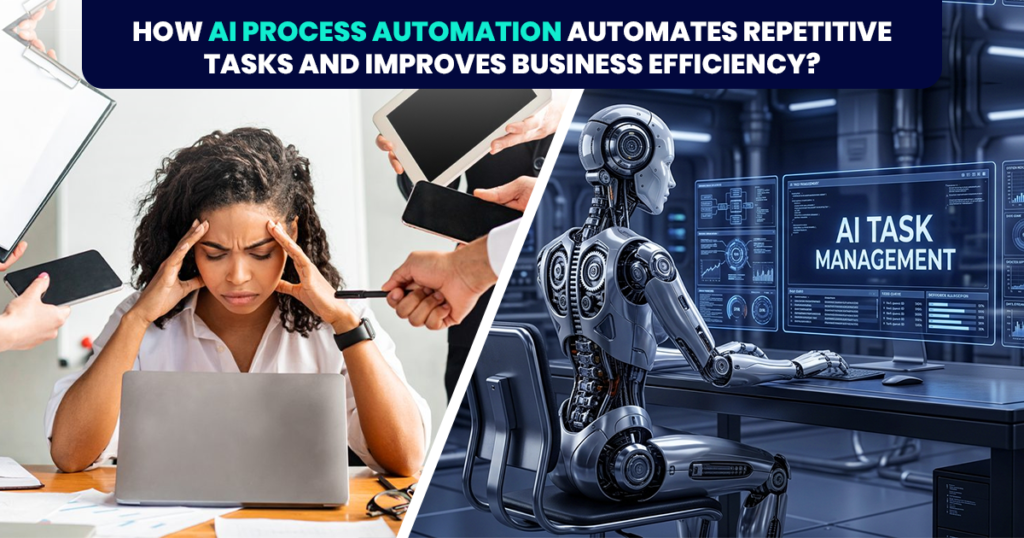
How AI Process Automation Automates Repetitive Tasks and Improves Business Efficiency?
Every Business Has a Hidden Time Leak
Every organization is faced with an internal problem that is not always apparent.
The problem does not stem from strategic and competitive aspects, but from the slow loss due to mundane activities performed on a day-to-day basis. These include data entry, processing invoices, pursuing clients, creating reports, and booking appointments, among other things. Each one of them seems unimportant in its own right, but collectively takes a toll on time and productivity. This is precisely where AI business process automation systems come into play in revolutionizing the way contemporary organizations function. In 2026, it was no longer only large companies that invested in such innovations. They are becoming increasingly available and affordable for everyone.
What AI Business Process Automation Really Means?
AI business process automation can be defined as the use of intelligent software to perform processes that would otherwise require manual effort performed by humans.It is different from conventional automation since it includes activities such as analyzing the problem, learning from it, adapting to the changes, and making informed decisions based on the analysis. Additionally, organizations will be able to have intelligent systems that work like a digital assistant. Based on studies, many employees are now utilizing AI in automating their tasks, saving them thousands of hours per week. As a result, what will be achieved is increased efficiency and fewer errors.
The Tasks AI Handles Best
It is at its best when it comes to tasks such as:
- Data entry
- Communicating with customers
- Scheduling
- Reporting
- CRM management
- Lead management
These kinds of tasks do not involve any need for creative solutions, just a requirement for consistent actions. That is what AI is more efficient at than people.
Why Manual Work Slows Business Growth?
Manual processes appear ordinary, but they silently hamper business growth. Some common challenges include:
- Inaccuracies in routine tasks performed by humans
- Stagnation during the approval process
- Increasing operating costs
- Lack of integration among the different departments’ data
AI-driven automation eliminates all such challenges by standardizing processes and integrating business data.
Where AI Automation Is Already Transforming Industries?
AI business process automation technology is currently being applied in many industries.
- In the health care sector, manpower will be saved by activities such as scheduling, billing, and patient intake through AI business process enterprise systems.
- For logistics firms, it provides dispatch, tracking, and route planning through artificial intelligence business process automation systems.
- In the real estate business, it provides lead management, follow-ups, and document management.
- For transportation and fleet management, it provides dispatch, driver management, and reporting.
The result of all these applications is that fewer human inputs will be needed.
AI Automation vs Traditional Automation
Traditional automation adheres to set rules. When there is a change, the system fails.
AI Automation is unique in that it is contextual, manages exceptions, deals with unstructured information, and evolves as well. It is this capability that makes companies prefer AI-based enterprise software solutions over static, rule-based systems.
How to Know If Your Business Is Ready?
Most businesses are already automated without even knowing it.
Ask yourself:
- Are you having trouble with employees wasting time performing repetitive tasks?
- Does anything get delayed due to the manual approvals system?
- Is there any difficulty in completing reports?
- Are you finding that scaling is difficult without hiring additional staff?
Then automation is a solution that could give you instant results. Current business process automation technologies for AI systems complement, rather than compete with, your existing solutions.
How Implementation Works in Practice?
The AI automation process consists of the following steps:
Step 1: Process Identification
Processes that can be repeated and have defined rules are included.
Step 2: Building Workflows
Automating AI should be integrated into the workflow using CRM, ERP, and other internal systems.
Step 3: Improving AI Processes
AI improvement is done through more data interactions.
Organizations can utilize both automation technologies and data and decision intelligence technologies.
How do AI Systems Work Better Together?
The efficiency of AI automation can be achieved through:
- AI data and decision intelligence systems for prediction and analytics.
- AI business process automation systems for process efficiency.
- AI enterprise systems for transforming the organization.
This makes up an intelligent business ecosystem.
Why AI Business Process Automation Is No Longer Optional?
These repetitive actions not only take up time but also stunt growth. AI uses intelligent systems for automation and continues to grow in that way. Such organizations that adopt this technology not only become efficient but also develop efficient systems.
Frequently Asked Questions (FAQs)
AI-driven technology used to automate repeatable processes within businesses is called AI business process automation.
These may include invoice creation, scheduling, customer support processes, report generation, and other administrative operations.
The current technologies of AI automation enable businesses of all sizes to employ this solution.
While traditional solutions operate under preset rules, AI solutions are flexible, deal with exceptions, and get better with time.
Implementation time frames are measured in weeks and depend on complexity and system integration.
Not at all, as it eliminates repetitive tasks and allows employees to concentrate on valuable work.
Yes, it is possible to integrate with CRM, ERP, and any contemporary business system.